Voeding, Farma, Product Compliance & Recht

Blog over Voedingsmiddelenwetgeving, cosmeticaregels, Europese wetgeving en geneesmiddelenrecht

Blog met kennisartikelen inzake het levensmiddelenrecht. Aandacht voor cosmeticawetgeving, Europese Regelgeving en juridisch advies farmaceutisch recht. Daarnaast juridische wetenswaardigheden en kantoorupdates van Slijpen Legal BV!

The Right to Process Data for Machine Learning Purposes in the EU

Harvard Law School, Harvard Journal of Law & Technology (JOLT) Online Digest 2020, Forthcoming

New interdisciplinary Stanford University AI & Law research article: “The Right to Process Data for Machine Learning Purposes in the EU”.

Data Act & European data-driven economy

Europe is now at a crucial juncture in deciding how to deploy data driven technologies in ways that encourage democracy, prosperity and the well-being of European citizens. The upcoming European Data Act provides a major window of opportunity to change the story. In this respect, it is key that the European Commission takes firm action, removes overbearing policy and regulatory obstacles, strenuously harmonizes relevant legislation and provides concrete incentives and mechanisms for access, sharing and re-use of data. The article argues that to ensure an efficiently functioning European data-driven economy, a new and as yet unused term must be introduced to the field of AI & law: the right to process data for machine learning purposes.

The state can implement new modalities of property

Data has become a primary resource that should not be enclosed or commodified per se, but used for the common good. Commons based production and data for social good initiatives should be stimulated by the state. We need not to think in terms of exclusive, private property on data, but in terms of rights and freedoms to use, (modalities of) access, process and share data. If necessary and desirable for the progress of society, the state can implement new forms of property. Against this background the article explores normative justifications for open innovation and shifts in the (intellectual) property paradigm, drawing inspiration from the works of canonical thinkers such as Locke, Marx, Kant and Hegel.

Ius utendi et fruendi for primary resource data

The article maintains that there should be exceptions to (de facto, economic or legal) ownership claims on data that provide user rights and freedom to operate in the setting of AI model training. It concludes that this exception is conceivable as a legal concept analogous to a quasi, imperfect usufruct in the form of a right to process data for machine learning purposes. A combination of usus and fructus (ius utendi et fruendi), not for land but for primary resource data. A right to process data that works within the context of AI and the Internet of Things (IoT), and that fits in the EU acquis communautaire. Such a right makes access, sharing and re-use of data possible, and helps to fulfil the European Strategy for Data’s desiderata.

Meer lezen

Computer generated works: wie of wat is eigenaar?

Deze column is gepubliceerd op platform VerderDenken.nl van het Centrum voor Postacademisch Juridisch Onderwijs (CPO) van de Radboud Universiteit Nijmegen. https://www.ru.nl/cpo/verderdenken/columns/computer-generated-works-eigenaar/

Nieuwe technologieën roepen nieuwe juridische vragen op. Zo ook computers die creatieve werken maken. Wie of wat is de eigenaar van zo’n werk? Mauritz Kop geeft uitleg.

Machines uitgerust met artificiële intelligentie (AI) begeven zich op het terrein van de schone kunsten. Computers schilderen, schrijven en componeren er ijverig op los. Zo genereerde The Next Rembrandt een 3D-geprint meesterwerk, schilderde The Art and Artificial Intelligence Lab een levensechte Mona Lisa, schreef Kurzweils Cybernetic Poet klassieke sonnetten en produceerde Amper Music een complete muziek-cd. Alles in luttele seconden.

Auteursrechten vestigen is problematisch

Het is voorstelbaar dat er auteursrechten rusten op de voortbrengselen van AI-systemen zelf, zoals kunst, muziek, literatuur, uitvindingen, industriële toepassingen, algoritmes, code en andersoortige scheppingen. Men kan zich als wetgever de vraag stellen of er voor computer generated works sui generis categorieën rechten (met een korte looptijd en zonder persoonlijkheidsrechten) in het leven moeten worden geroepen.

Kunnen IE-rechten überhaupt AI-scheppingen beschermen?

De wet in haar huidige vorm erkent geen niet-menselijke auteursrechten. Auteurschap is fundamenteel verbonden met menselijkheid; met scheppingen van de menselijke geest. Dat vloeit bijvoorbeeld voort uit het bekende Infopaq-arrest van het EU Hof van Justitie uit 2009, al is dit arrest niet geschreven met machine learning en kunstmatige intelligentie in het achterhoofd. Is het dogmatisch en doctrinair correct om aan te nemen dat er geen copyright kan zijn op pure AI creations? AI is per slot van rekening niet menselijk en er is bovendien geen menselijke originaliteit en creativiteit aanwezig. Het korte antwoord luidt: ja.

Algoritmisch auteurschap: goed idee of niet?

In tegenstelling tot de benadering van de EU en de VS, heeft het Verenigd Koninkrijk een computer generated works-regime geïmplementeerd, wat betekent dat de programmeur van de AI het auteursrecht krijgt op de output van de machine. Met andere woorden: het VK, en recentelijk ook de Chinese rechter, breiden het menselijke auteurschap uit naar algoritmisch auteurschap.

AI-machine kan geen copyright bezitten

Auteursrechten kunnen alleen eigendom zijn van rechtssubjecten, dus personen of bedrijven. Een AI-machine kan zelf geen copyright bezitten op AI made creations omdat een AI-systeem geen rechtssubjectiviteit en ook geen rechtspersoonlijkheid bezit. AI-systemen kwalificeren als rechtsobject, niet als rechtssubject.

‘Publiek eigendom uit de machine’ en menselijke interventie

Menselijk auteurschap blijft het normatieve orgelpunt van het intellectuele eigendomsrecht. Delen van het meerlagige, uit het Romeinse recht afkomstige eigendomsparadigma kunnen relevant zijn voor AI. Voortbouwend op dit raamwerk is er een nieuw publiek domein model denkbaar voor AI creations and inventions die de autonomiedrempel overschrijden: res publicae ex machina (publiek eigendom uit de machine).

Meer lezen
Machine Learning & EU Data Sharing Practices

Stanford - Vienna Transatlantic Technology Law Forum, Transatlantic Antitrust and IPR Developments, Stanford University, Issue No. 1/2020

New multidisciplinary research article: ‘Machine Learning & EU Data Sharing Practices’.

In short, the article connects the dots between intellectual property (IP) on data, data ownership and data protection (GDPR and FFD), in an easy to understand manner. It also provides AI and Data policy and regulatory recommendations to the EU legislature.

As we all know, machine learning & data science can help accelerate many aspects of the development of drugs, antibody prophylaxis, serology tests and vaccines.

Supervised machine learning needs annotated training datasets

Data sharing is a prerequisite for a successful Transatlantic AI ecosystem. Hand-labelled, annotated training datasets (corpora) are a sine qua non for supervised machine learning. But what about intellectual property (IP) and data protection?

Data that represent IP subject matter are protected by IP rights. Unlicensed (or uncleared) use of machine learning input data potentially results in an avalanche of copyright (reproduction right) and database right (extraction right) infringements. The article offers three solutions that address the input (training) data copyright clearance problem and create breathing room for AI developers.

The article contends that introducing an absolute data property right or a (neighbouring) data producer right for augmented machine learning training corpora or other classes of data is not opportune.

Legal reform and data-driven economy

In an era of exponential innovation, it is urgent and opportune that both the TSD, the CDSM and the DD shall be reformed by the EU Commission with the data-driven economy in mind.

Freedom of expression and information, public domain, competition law

Implementing a sui generis system of protection for AI-generated Creations & Inventions is -in most industrial sectors- not necessary since machines do not need incentives to create or invent. Where incentives are needed, IP alternatives exist. Autonomously generated non-personal data should fall into the public domain. The article argues that strengthening and articulation of competition law is more opportune than extending IP rights.

Data protection and privacy

More and more datasets consist of both personal and non-personal machine generated data. Both the General Data Protection Regulation (GDPR) and the Regulation on the free flow of non-personal data (FFD) apply to these ‘mixed datasets’.

Besides the legal dimensions, the article describes the technical dimensions of data in machine learning and federated learning.

Modalities of future AI-regulation

Society should actively shape technology for good. The alternative is that other societies, with different social norms and democratic standards, impose their values on us through the design of their technology. With built-in public values, including Privacy by Design that safeguards data protection, data security and data access rights, the federated learning model is consistent with Human-Centered AI and the European Trustworthy AI paradigm.

Meer lezen
Data delen als voorwaarde voor een succesvol AI-ecosysteem

Trainingsdatasets voor kunstmatige intelligentie: enkele juridische aspecten

Data delen (data sharing) of liever het vermogen om hoge kwaliteit trainingsdatasets te kunnen analyseren om een AI model -zoals een generative adversarial network- te trainen, is een voorwaarde voor een succesvol AI-ecosysteem in Nederland.

In ons turbulente technologische tijdperk nemen fysieke aanknopingspunten als papier of tastbare producten binnen de context van data -of informatie- in belang af. Informatie is niet langer aan een continent, staat of plaats gebonden. Informatietechnologie zoals kunstmatige intelligentie ontwikkelt zich in een dermate hoog tempo, dat de juridische problemen die daaruit voortvloeien in belangrijke mate onvoorspelbaar zijn. Hierdoor ontstaan -kort gezegd- problemen voor tech startups en scaleups.

In dit artikel een serie -mede in onderlinge samenhang te beschouwen aanbevelingen, suggesties en inventieve oplossingen om anno 2020 tot waardevolle nationale en Europese dataketens te komen.

Data donor codicil

Introductie van een Europees (of nationaal) data donor codicil waarmee een patiënt of consument vrijwillig data kan doneren aan de overheid en/of het bedrijfsleven, AVG-proof. Hier kunnen waardeketens worden gecreëerd door de sensor data van medische Internet of Things (IoT) apparaten en smart wearables van overheidswege te accumuleren. Anoniem of met biomarkers.

Data interoperabel en gestandaardiseerd

Unificatie van data uitwisselingsmodellen zodat deze interoperabel en gestandaardiseerd worden in het IoT. Een voorbeeld is een Europees EPD (Elektronisch Patiënten Dossier), i.e een Electronic Healthcare Record (EMR). AI certificering en standaardisatie (zoals ISO, ANSI, IEEE / IEC) dient bij voorkeur niet te worden uitgevoerd door private partijen met commerciële doelstellingen, maar door onafhankelijke openbare instanties (vergelijk het Amerikaanse FDA).

Machine generated (non) personal data

Een andere categorisering die we kunnen maken is enerzijds publieke (in handen van de overheid) machine generated (non) personal data, en private machine generated (non) personal data. Met machine generated data bedoelen we met name informatie en gegevens die continue door edge devices worden gegenereerd in het Internet of Things (IoT). Deze edge devices staan via edge (of fod) nodes (zenders) in verbinding met datacenters die samen met edge servers de cloud vormen. Deze architectuur noemen we ook wel edge computing.

Juridische dimensie

Data, of informatie heeft een groot aantal juridische dimensies. Aan data delen kleven potentieel intellectueel eigendomsrechtelijke (verbodsrecht en vergoedingsrecht), ethische, grondrechtelijke (privacy, vrijheid van meningsuiting), contractenrechtelijke en internationaal handelsrechtelijke aspecten. Juridisch eigendom op data bestaat anno 2020 niet omdat het -vanuit goederenrechtelijk oogpunt- niet als zaak wordt gekwalificeerd. Data heeft wel vermogensrechtelijke aspecten.

Meer lezen
Cursus AI, Data, Privacy en Innovatie in de Zorg

Suzan Slijpen, Sander Ruiter en Mauritz Kop over AI in de Zorg

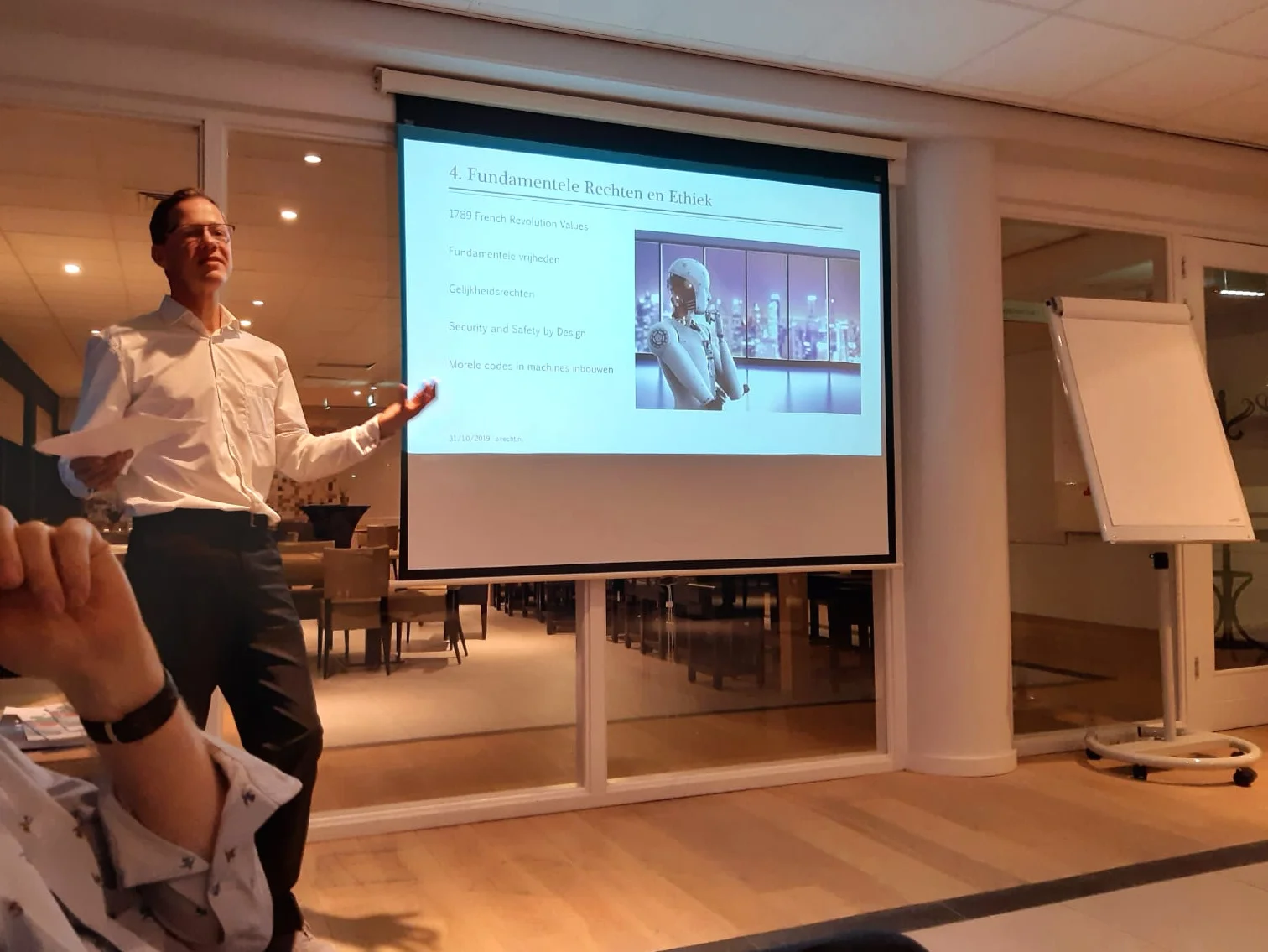
Op 31 oktober 2019 gaven Suzan Slijpen, Sander Ruiter en Mauritz Kop een cursus AI, Data, Privacy en Innovatie in de Zorg in het Maasstad Ziekenhuis Rotterdam. Wij waren daar te gast op uitnodiging van Quint Wellington Redwood, een leading consultancy firm die organisaties ondersteunt bij het ontwerpen en operationaliseren van hun digitale strategie waarbij mensen, processen en technologie centraal staan.

Gebruik van patiëntgegevens, medische hulpmiddelen, datadelen, privacy & AI in het ziekenhuis

Doel van cursus was om helderheid te scheppen in de wettelijke regels over het gebruik van patiëntgegevens, datadelen, eigendom van trainingsdatasets, medical devices, privacy en artificiële intelligentie in het ziekenhuis. AIRecht werd ingeschakeld om expertise te geven over dit complexe en uitdagende onderwerp. Om barrières weg te nemen voor innovatie. Onder de aanwezigen waren het Maasstad Ziekenhuis Rotterdam management team, de CISO (Chief Information Security Officer), enkele artsen, radiologen en verpleegkundigen. Ook waren er data scientists uitgenodigd van Parnassia Groep, specialisten in geestelijke gezondheid.

Keynote Digitale Zorg - Medical Devices, Patiëntdata, MDR & AVG

Nieuwe Europese regelgeving (MDR) voor Medical Devices waaronder zorgrobots, medische producten, hulpmiddelen en medische software vanuit een AI-helicopterview, die in 2020 in Nederland van kracht wordt. Verhouding tussen de AVG en de MDR. Gebruik en uitwisseling van patiëntdata, informatiebeveiliging en digitale zorg: wat mag er wel en niet op basis van de Europese Privacywetgeving (AVG/GDPR)?

Meer lezen
Suzan Slijpen Conference Speaker at the National University of Ireland

Legal Aspects of AI in Healthcare

On 16 August 2019, Suzan Slijpen LL.M. had the honour to speak about the legal aspects of the development and use of artificial intelligence (a disruptive technology) in healthcare, at the AI in Medicine Conference organized by the Irish Association of Physicists in Medicine (IAPM). The conference took place in Galway, at the National University of Ireland (School of Physics, NUI Galway/ OÉ Gaillimh). Suzan is a senior legal consultant at AIRecht.nl, and specializes in eHealth & medical devices, pharmaceutical law, European food law and contract law, from an AI helicopterview. She is also founder and lawyer at boutique law office Slijpen Legal.

Key topics of the Artificial Intelligence in Medicine lecture

Key legal topics that Suzan addressed in her Artificial Intelligence in Medicine lecture:

1. AI & Robotics: Disruptive Technologies: Synergetic effects of 4th Industrial Revolution technologies like robotics, big data, quantum computing, Blockchain, Virtual Reality (VR) and Internet of Things (IoT).

2. eHealth and medical devices: legal classification.

3. Fundamental Rights: Safeguarding of Fundamental Rights in AI applications, Rights of Patients.

4. Ethics and responsible AI: 1791 French Revolution Values, HLEG Concept of Trustworthy AI.

5. Intellectual Property on AI and Health Apps: Licensing your IP.

6. Liability for damages caused by smart robots: who is liable for misdiagnosis by an AI algorithm?

7. Legislation and Jurisprudence.

8. AI Impact Assessment: remove roadblocks for AI.

Legislation and regulations regarding AI in Healthcare

Do you want to know more about legislation and regulations regarding AI in Healthcare, or Legal aspects of disruptive tech in Medicine? Or do you want to organize a workshop or conference yourself and invite us as a speaker or teacher? Then please contact us about the possibilities!

Meer lezen
AI Trade Mission to Boston with Prime Minister Mark Rutte

AIRecht.nl lawyers Mauritz Kop and Suzan Slijpen joined the Dutch AI trade mission to Boston, Massachusetts led by Prime Minister Mark Rutte and Minister Bruno Bruins. It was a big success. We visited leading companies in health care, climate, and robotics and AI and participated in high quality meetings and events at -inter alia- Harvard Wyss Institute, MIT, IBM Watson, Amazon Robotics, Humatics and Philips Healthworks R&D HQ USA.

AI-Chefsache interview

During debriefing at the Museum of Fine Arts & Koch Gallery, Prime Minister Mark Rutte and Mauritz Kop reflected on AI becoming Chefsache, the concept of Trustworthy AI, exporting European ethical values to the USA via the Dutch AI Impact Assessment (ECP), and building a strong and vibrant AI ecosystem in The Netherlands.

AIRecht.nl website included in IBM Watson presentation

We were honoured and thrilled to see that Nicola Palmarini, Global Manager AI for Healthy Aging IBM Research - MIT/IBM Watson AI Lab Cambridge and Tedx Speaker, included our AIRecht.nl website in his presentation about the moral, legal and ethical implications of AI, at IBM Watson Health Experience Centre.

Building on shared expierences

Learning and building on shared experiences is a two way street. During the mission, we gathered knowledge of the technological state of the art in Robotics & AI. We shared our own latest research insights on AI & IP, open access, public domain and ethics that facilitate innovation with influential academic institutions and ambitious, frontrunning entrepreneurs. This blog contains a photo report of our economic mission to the beautiful city of Boston.

Meer lezen
Etikettering en labelling van voedingsmiddelen en voedingssupplementen

Verkoopt u voedingsmiddelen en/of voedingssupplementen? Dan dient u ervoor te zorgen dat het etiket op de verpakking voldoet aan een aantal bijzondere regels. De samenstelling van het product, de voedingswaarden en de eventueel aanwezige allergenen moeten worden vermeld. Claims inzake bijzondere voedingswaarden of eigenschappen van eet- en drinkwaar mogen niet in strijd zijn met de Claimsverordening. Onterechte gezondheidsclaims in reclame-uitingen of op het etiket zijn niet toegestaan.

De verstrekking van voedselinformatie aan consumenten

Het is van het grootste belang dat etikettering en labelling van levensmiddelen (eten en drinken) op de juiste wijze geschiedt: de informatie moet nauwkeurig en correct zijn. Daarbij dient men rekening te houden met een veelvoud aan nationale en internationale regelgeving, waaronder de Codex Alimentarius.

Etiketten en labels – wat wordt er van u verwacht?

Waar moet de levensmiddelensector aan voldoen op het gebied van etikettering? Wat moet er op het etiket staan?

Het etiket dient duidelijk, leesbaar, begrijpelijk en niet misleidend te zijn. Dat is echter niet alles. De wet stelt bijzondere regels over verstrekking van informatie inzake samenstelling en (generieke) aanduiding van het product, de aanduiding van inhoud of hoeveelheid, de volgorde van de gebruikte ingrediënten, houdbaarheid en herkomst, om maar eens iets te noemen. Consumenten dienen adequaat te worden geinformeerd over E-nummers, additieven, enzymen, smaak- en kleurstoffen.

In deze bijdrage gaan we nader in op de wettelijke regels inzake de verstrekking van voedselinformatie aan consumenten.

Meer lezen
CRISPR-Cas valt voortaan onder strenge GMO-wetgeving

Vorige week, op 25 juli 2018, deed het Europees Hof van Justitie uitspraak inzake het gebruik van nieuwe- subtiele- gewasveredelingstechnieken. Het gebruik van technieken die leiden tot aanpassingen in het DNA van planten, zoals CRISPR-Cas, komt volgens het Hof neer op genetische modificatie. Daarom vallen deze innovatieve technieken voortaan onder de strenge GMO-wetgeving.

Mutagene technieken niet meer vrijgesteld van GMO-wetgeving

Het Hof zet nu een rem op innovatie: nieuwe mutagenese technieken zoals CRISPR-Cas moeten voortaan voldoen aan de wettelijke vereisten inzake voorzorgsmaatregelen, risicobeoordeling en traceerbaarheid. CRISPR-Cas valt voortaan dus onder strenge GMO-wetgeving.

Meer lezen
Slijpen Legal spreker op Science Honours Academy Symposium over GMO’s

The EU Regulatory Framework on GM Food and Market Authorisation

Maandag 4 juni jl. had ik de eer om aanwezig te zijn bij en te spreken op het door de Science Honours Academy van de Universiteit Utrecht georganiseerde symposium over genetisch gemodificeerde organismen.

Science Honours Academy

Verzoek was om deze zeer gemotiveerde groep Science Honours studenten iets te vertellen over de Europese wet- en regelgeving inzake genetisch gemodificeerde organismen (GGO’s) oftewel genetically modified organisms (GMO’s). GMO’s kunnen op tal van manieren worden aangewend, maar een zeer belangrijke toepassing ligt op het gebied van landbouw en levensmiddelenproductie.

Meer lezen